
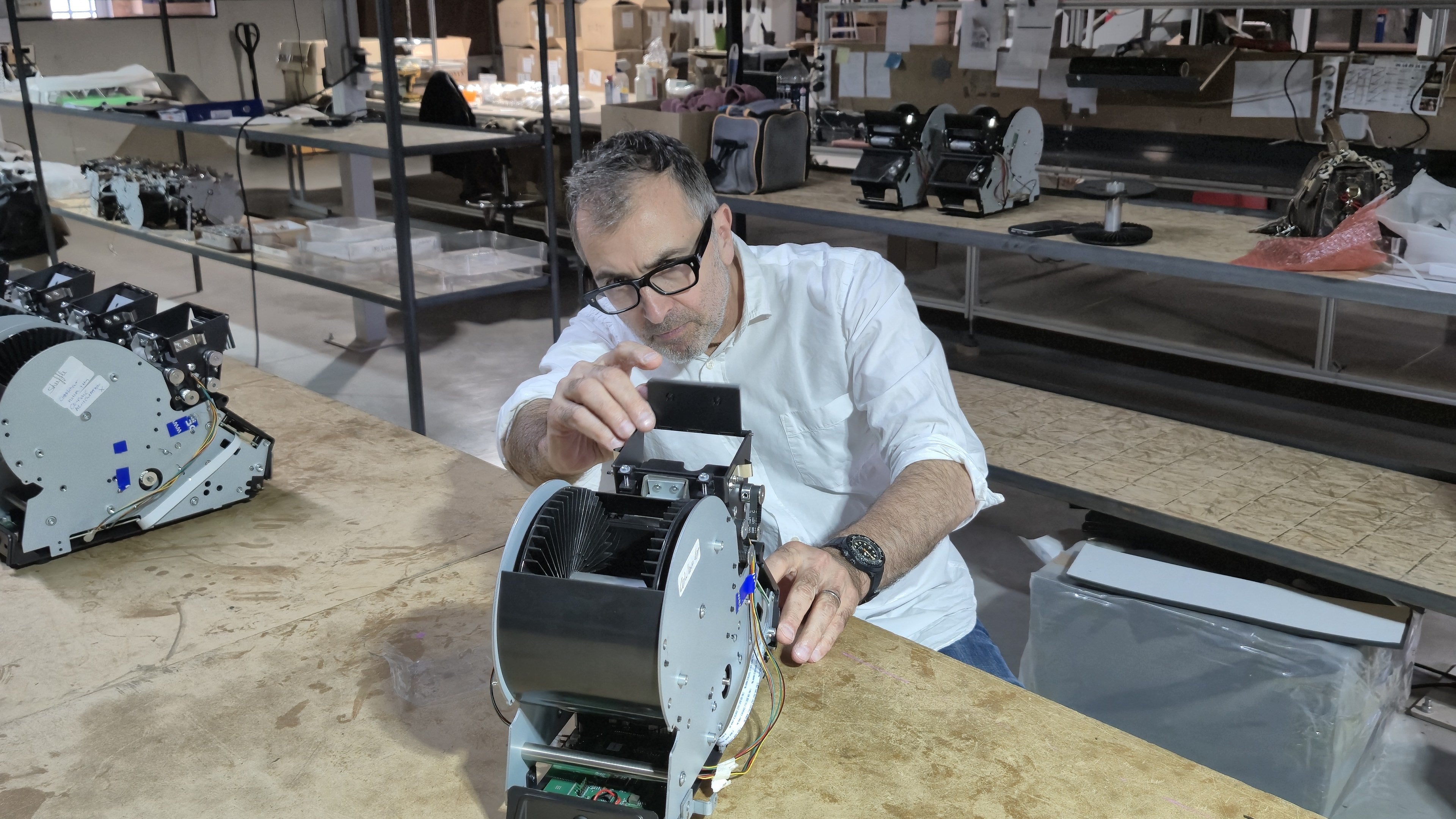
Designed for his own table
François wanted a shuffler that could guarantee a truly random shuffle, made to the standards he knew from luxury goods. He designed LeShuffler for his own games.
A card game begins before the first card is dealt. It begins with the shuffle.
François is an engineer who spent part of his career in France, in luxury leather goods, ready-to-wear and accessories: objects people hold, wear and carry, where the inside is held to the same standard as the outside and the finish must survive being handled every day.
François is interested in mathematics, especially randomness. Most weeks, he also plays card games with friends and family. LeShuffler is where the two came together.
Mechanical shuffling has its limits. Bayer and Diaconis showed that eight hand riffles still leave enough order for a card trick to give an advantage. In an experiment published by M. P. Silverman, a machine took 11 or 12 riffles to mix as thoroughly as seven or eight by hand. The result also depends on physical parameters that change with use.
Calculation does not provide true randomness either. Most electronics use pseudo-random generators, where numbers are produced by an algorithm from a starting value. As the great mathematician John von Neumann famously put it: “Anyone who attempts to generate random numbers by deterministic means is, of course, living in a state of sin.”
True randomness comes from physical phenomena. That principle shaped LeShuffler: every card’s position is drawn from a true random number generator built into its controller, using a live analogue physical signal as its source.
205 backers made it better
Kickstarter brought LeShuffler 205 backers, 477% of its goal and the “Project We Love” distinction.
More importantly, it brought the first people to use the machine. Their feedback became part of the product.
Backers helped bring in self-tuning that adapts each individual LeShuffler to the specific cards being used, and a quieter, grippier loading system. They also prompted the move to USB-C Power Delivery, which allows LeShuffler to run from a 65 W USB-C power bank.
The games themselves were shaped with the backers from the start. The preset list was established with their feedback, and later requests added more (5 Card Omaha, 6 Card Omaha and 2 Board Omaha). The two-deck mode, shuffling up to 108 cards, was also suggested by the community.
Backers also suggested additional ways to deal: preparing the players’ cards in the internal tray for a human dealer to hand out, and emptying LeShuffler automatically at the end of a game.
Many are still helping us improve and develop it.
Made in France, finished by hand
LeShuffler was designed in France and the UK and is made in France.
To take LeShuffler from a working proof of concept to a product ready for manufacture, François turned to Stefan Knox and his team at Bang Creations, the UK product design and engineering studio Stefan founded. Stefan drew the original shell, giving the machine its distinctive shape. The carousel, card path and mechanisms set its outline: the rounded back follows the wheel, while the profile wraps around the parts inside. The task was to make that shape compact, balanced, good-looking and recognisable. Stefan and Sarah Cheetham, a senior design engineer at Bang, rearranged the internal layout to raise the front edge, angle the screen towards the player and leave room to lift the shuffled deck from the front tray.
Its shell is mirror-polished stainless steel. The side panels are walnut veneer on Finnish birch multi-ply, a construction used for high-end hi-fi cabinets.
The main dial is machined from solid stainless steel and is turned and pressed to navigate the menus; the colour screen sits protected behind mineral glass. It gives LeShuffler the physical, analogue feel of classic mechanical machines: a control you find by feel, always in the same place.
Every machine is assembled, adjusted and given its final polish by hand in our French workshop, then individually calibrated before it leaves. Its card path is set by hand to within 0.05 mm.